European Alternatives to UptimeRobot, Pingdom & BetterStack
EU-hosted replacements for every US monitoring tool — with free tiers, verified jurisdictions, and prices, plus a migration checklist for one afternoon.
The European SaaS ecosystem has matured. Where five years ago you had to use US tools because there were no alternatives, today there’s an EU-based option for nearly every monitoring need.
This guide maps out the best European alternatives across every monitoring category — uptime monitoring, cron/heartbeat monitoring, status pages, and all-in-one platforms. Every jurisdiction claim below was re-verified against the vendor’s own legal documents on 2026-07-03, and two of them will surprise you: one “EU” favourite is actually a US corporation, and one “US incumbent” is legally Maltese. Whether you’re switching for GDPR compliance, CLOUD Act concerns (the statute itself sits at 18 U.S.C. §2713), or simply because you prefer European tools, this is your starting point.
Why Switch from US to EU Monitoring Tools?
The short version:
- Legal certainty — EU companies are not subject to the US CLOUD Act, and the Schrems II ruling (CJEU C-311/18) made clear that SCCs alone cannot bridge that gap
- GDPR-native — built for EU law, not retrofitted with SCCs
- Data residency — your data stays in the EU, period
- Customer trust — “hosted in the EU” is increasingly a selling point, especially for organisations subject to the NIS2 Directive (EU) 2022/2555 and similar availability/security obligations
For the detailed version, read why your monitoring data shouldn’t leave the EU.
First: What You’re Actually Replacing
A quick jurisdiction check on the three incumbents, from their own legal documents (verified 2026-07-03):
- UptimeRobot — legally Maltese and EU-incorporated (Uptime Robot Service Provider Ltd., Sliema, owned by itrinity s.r.o., Slovakia), so calling it American is technically wrong. But its privacy policy names US infrastructure providers (AWS, Limestone Networks, DigitalOcean) and permits storage outside the EEA — EU company, non-EU data path. Free tier: 50 monitors at 5-minute intervals; paid from $9/month.
- Pingdom — owned by SolarWinds (Austin, Texas — US jurisdiction). No free tier; Synthetics plans reportedly start around $15/month (their pricing page renders prices via JavaScript, so treat exact numbers as approximate).
- BetterStack — Better Stack, Inc., a Delaware corporation per its own privacy policy, despite Prague roots and “primarily EU” processing. Free tier: 10 monitors at 3-minute checks. We cover it in depth in the BetterStack alternative comparison.
All-in-One Platforms
These tools combine monitoring, status pages, and alerting in a single platform.
FoundersDeck 🇩🇪
The EU-first monitoring platform built for founders. Combines uptime monitoring (HTTP, Ping, Keyword), heartbeat/cron monitoring for background jobs and scheduled tasks, public status pages, multi-channel alerts, and uptime badges. Operated by a German Einzelunternehmen; all data stored in Nuremberg, Germany — the full sub-processor register is public on the trust page.
- Pricing: Free tier (5 monitors + status page), paid from €9/month
- Standout: Heartbeat/cron monitoring, cookie-free status pages, incident classification, instant DPA
- Best for: EU founders, indie hackers, SaaS teams
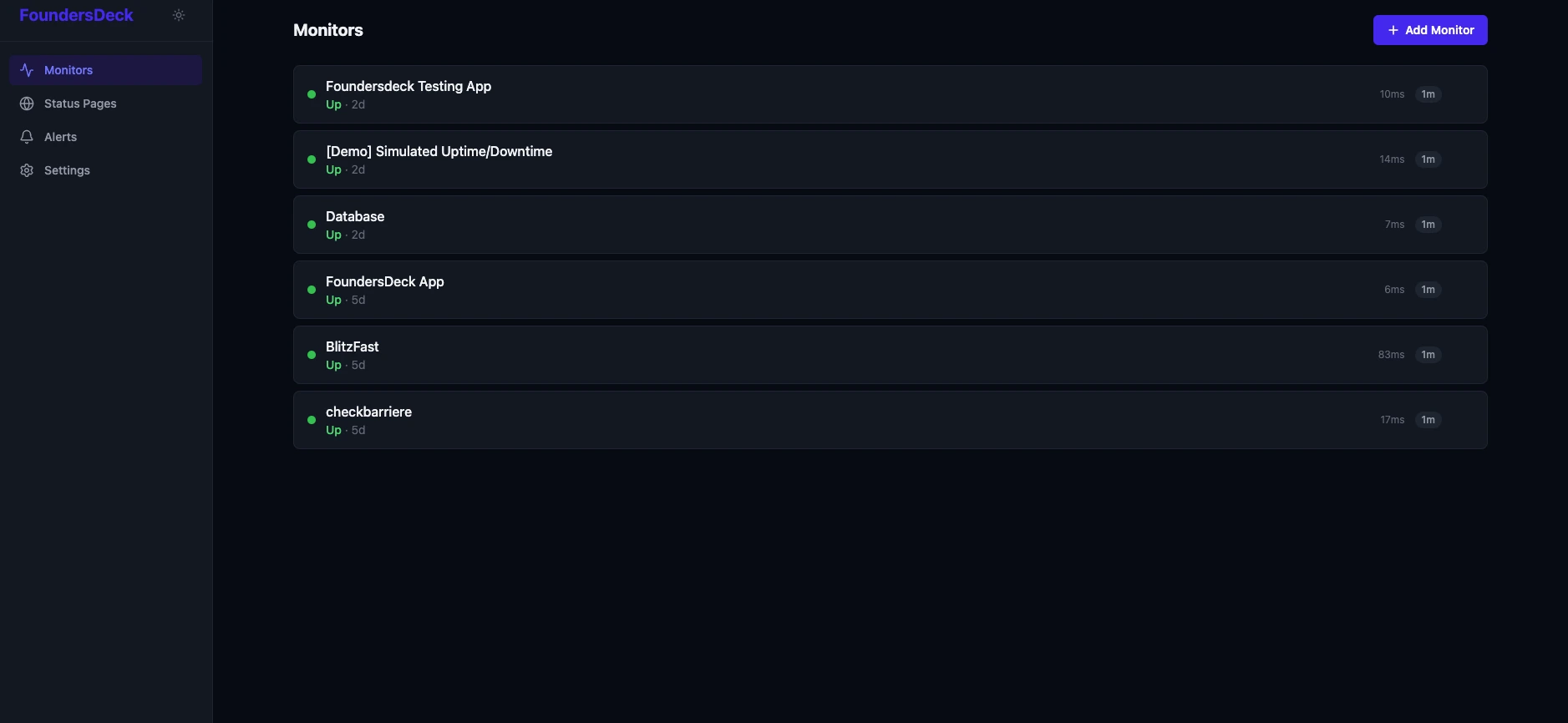
Replaces: UptimeRobot (see comparison), BetterStack (see comparison), Pingdom (see comparison)
Oh Dear 🇧🇪
Belgian monitoring platform built by the Spatie team (Immutable VOF, Berlaar — the entity behind the beloved Laravel packages). Uptime and broken-page checks, SSL health, Lighthouse performance, DNS and domain expiration, scheduled-task (cron) monitoring, application health, and status pages. Primary data storage is in Belgium with the ISO 27001-certified provider Combell, and a public DPA is available.
- Pricing: From €13/month (Mini, 5 sites) up to €201/month (200 sites); no free tier — 10-day trial plus a 30-day money-back guarantee
- Standout: Broken link and mixed-content checks, cron monitoring, deep Laravel integration
- Best for: PHP/Laravel teams who want comprehensive web health checks from one vendor
Phare 🇪🇪
Often mislabelled as French (the name doesn’t help) — Phare is operated by Lightkeeper OÜ in Tallinn, Estonia. Modern uptime monitoring, SSL checks, incident management, and status pages, with EU infrastructure (analytics hosted in Germany, backups on Scaleway).
- Pricing: Free Hobby plan (capped by monitoring events, not monitor count — 100,000 events/month); Scale from €5/month base plus usage
- Standout: Unusually generous free plan — features are unlimited, only event volume is capped
- Best for: Small teams wanting modern, affordable EU monitoring
Uptime Monitoring (Standalone)
Uptime Kuma 🌍 (Self-Hosted)
Open-source, self-hosted monitoring with 90+ check types. Host it on your own EU server for complete data control. Very much alive: version 2.4.0 shipped in May 2026, the repo is pushed to daily, and it has ~89,000 GitHub stars.
- Pricing: Free (your server costs)
- Standout: No vendor dependency, complete data control
- Best for: DevOps teams who can manage their own infrastructure — you own uptime monitoring for your uptime monitor
Hyperping 🇫🇷
French monitoring (Hyperping SAS, Paris) with a clean interface and status pages. European directories report monitoring data is stored in a Frankfurt datacenter, though Hyperping’s own docs don’t state the location explicitly — ask them to confirm in writing if residency is a hard requirement.
- Pricing: Free tier — 20 monitors at 5-minute intervals with a basic status page; paid from $24/month (annual billing)
- Standout: Genuinely usable free tier from an EU company
- Best for: Small teams and API-focused products
HetrixTools ⚠️ (US-incorporated — read before choosing)
Frequently recommended as an “EU option” because of its Romanian founder — but the legal entity is HetrixTools, Inc., registered in the United States (Beaverton, Oregon, per its own about page). That puts it under CLOUD Act jurisdiction like any other US corporation. The product itself is solid and the free tier is the most generous in this list.
- Pricing: Free for life — 15 uptime + 15 server monitors at 1-minute intervals; paid from $9.95/month
- Standout: Blacklist monitoring, 1-minute checks on the free tier
- Best for: Budget-conscious teams without EU jurisdiction requirements
StatusCake 🇬🇧 (UK — adequacy, not EU)
UK-based (TrafficCake Limited). Post-Brexit, the UK is a third country under GDPR with an adequacy decision (renewed 2025) — transfers are lawful, but the UK sits outside the EU legal order and adequacy can be revoked. Know which requirement you actually have.
- Pricing: Free tier — 10 monitors at 5-minute intervals; paid from ~€16.66/month (annual)
- Standout: Mature product, page-speed and domain/SSL monitoring included
- Best for: Teams for whom UK adequacy is sufficient
Cron & Heartbeat Monitoring
Healthchecks.io 🇱🇻
Cron and heartbeat monitoring done right, by SIA Monkey See Monkey Do in Riga, Latvia (EU). Hosted on Hetzner infrastructure; also fully open source (BSD) if you’d rather self-host. Note it monitors scheduled jobs, not HTTP uptime — it pings you when your cron job doesn’t check in.
- Pricing: Free — 20 checks; paid from $5/month
- Standout: Purpose-built heartbeat monitoring, open source, EU entity
- Best for: Teams that only need cron/background-job monitoring
If you want heartbeat monitoring and uptime and status pages in one EU tool, that combination is exactly the gap FoundersDeck fills.
Status Pages
Statuspal 🇩🇪 (choose the EU region!)
German company (StatusPal UG, Berlin) with an API-first status page product — but here’s the nuance most roundups miss: the default region is US (statuspal.io). EU data residency requires signing up on the separate EU region (statuspal.eu, servers in Frankfurt) or migrating an existing page. German legal entity ≠ German servers by default.
- Pricing: From $46/month (Hobby); no free tier, 14-day trial
- Standout: Status-page-first product with deep customization and unlimited public pages on all tiers
- Best for: Teams where the status page is the primary need — on the EU region
Instatus 🌍 (not EU)
Modern status page tool with beautiful designs. While popular, Instatus is not EU-based — data is processed in the US.
- Pricing: Free tier available
- Standout: Best-looking status pages
- Best for: Teams without EU data residency requirements
Cachet 🌍 (Self-Hosted)
Open-source PHP status page system. Host it yourself for complete control.
- Pricing: Free
- Standout: Self-hosted, fully customizable
- Best for: Teams with DevOps capacity
Worth an aside: if you need full infrastructure observability (hosts, services, networks) rather than website uptime, Checkmk (Checkmk GmbH, Munich) is the German heavyweight — including a hosted Checkmk Cloud edition. It’s enterprise-grade and priced accordingly; overkill for a founder’s uptime + status page needs.
Quick Decision Matrix
| Your Need | Best EU Choice | Why |
|---|---|---|
| All-in-one for founders | FoundersDeck 🇩🇪 | Monitoring + heartbeat/cron + status pages + alerts, German-hosted, free tier |
| Comprehensive web health (Laravel) | Oh Dear 🇧🇪 | Broken links, certificates, DNS, cron, uptime — Belgian entity + Belgian hosting |
| Free EU monitoring | Hyperping 🇫🇷 / Phare 🇪🇪 / FoundersDeck 🇩🇪 | All three have real free tiers from EU-incorporated companies |
| Cron jobs only | Healthchecks.io 🇱🇻 | Purpose-built heartbeat monitoring, Latvian entity, 20 checks free |
| Full control, self-hosted | Uptime Kuma 🌍 | Free, open-source, actively maintained, your infrastructure |
| Status page primary | Statuspal 🇩🇪 (EU region) | German company, API-first — but sign up on statuspal.eu, not .io |
And two to re-classify from other roundups: HetrixTools is a US corporation (CLOUD Act applies), and StatusCake is UK (adequacy decision, not EU jurisdiction).
The Migration Path (One Afternoon, Honestly)
Switching monitoring tools is mostly waiting for DNS. The concrete steps:
- Export your monitor list. UptimeRobot’s API works on the free plan —
getMonitorsreturns every monitor with type, interval, and alert contacts (rate limit: 10 requests/minute). Pingdom users: create a read-only token under Settings → Pingdom API, thenGET https://api.pingdom.com/api/3.1/checks(docs). BetterStack users: the Uptime API route works the same way. - Recreate monitors in the new tool. For 5–50 monitors this is under half an hour anywhere. Heartbeat/cron monitors get new ping URLs — update your crontabs and CI configs to ping both old and new during the transition.
- Rebuild alert channels by hand. Slack, Discord, webhook, and email integrations never migrate between providers. Re-add them and fire a test alert before you rely on them.
- Move the status page without breaking the URL. If your status page runs on a custom domain (a CNAME like
status.yourcompany.com), configure the same domain at the new provider first, verify it renders, then flip the CNAME. Bookmarks and past incident links keep working. - Run both in parallel for 2–4 weeks. No monitoring tool imports another vendor’s uptime history — the overlap builds a fresh baseline and lets you compare alert behaviour on a real incident before you cancel the old subscription.
Frequently Asked Questions
Is UptimeRobot a US company or EU-owned?
No — its legal entity is Maltese (Uptime Robot Service Provider Ltd., part of the Slovak itrinity group). But its privacy policy names US infrastructure providers (AWS, Limestone Networks, DigitalOcean) and permits storage outside the EEA. EU company, non-EU data path — each of those transfers needs post-Schrems II safeguards.
Are there free EU-hosted uptime monitoring tools?
Yes: FoundersDeck (Germany, 5 monitors + status page), Hyperping (France, 20 monitors at 5-minute intervals), Phare (Estonia, event-capped free plan), and Healthchecks.io (Latvia, 20 cron checks). Self-hosting Uptime Kuma on an EU server is also free. HetrixTools’ generous free tier comes with US jurisdiction attached.
Is StatusCake an EU company?
No — it’s UK-based. The UK holds a GDPR adequacy decision (renewed 2025), so transfers are lawful without extra paperwork, but the UK is outside the EU legal order. Strict EU-jurisdiction requirements rule it out; adequacy-based requirements don’t.
How long does migrating monitoring tools take?
Most teams finish the mechanical part in one afternoon: API export, monitor re-creation, alert-channel rebuild, and a status-page CNAME flip. The full migration takes 2–4 weeks only because you should run old and new in parallel — uptime history can’t be imported, so the overlap is your new baseline.
The Bottom Line
The argument that “there are no EU alternatives” hasn’t been true for years. Whether you need a full platform, a specialized monitoring tool, or a self-hosted solution, there’s an EU option that matches your requirements — the harder problem in 2026 is that several tools marketed as European aren’t (HetrixTools: US Inc.; Statuspal’s default region: US; StatusCake: UK), which is why we verify jurisdiction against legal documents in our EU jurisdiction database.
The question isn’t whether alternatives exist — it’s whether you’re ready to make the switch. Start with a free tier, run it alongside your current tool, and see for yourself. For regulated industries with real evidence obligations — such as healthcare vendors and providers — we’ve summarized the requirements for EU-hosted monitoring on a dedicated page: GDPR-compliant monitoring for healthcare.

Engin Yildirim
Founder of FoundersDeck. 13+ years in software engineering. Building EU-first tools for founders.
Read more about me →