8 Best GDPR Uptime Monitoring Tools 2026 (EU-Hosted)
8 GDPR uptime monitoring tools for 2026, jurisdictions verified against vendor legal docs — one turned out US-incorporated. Free tiers, prices & DPAs compared.
Choosing a monitoring tool used to be simple: pick the one with the best features for your budget. But in 2026, for EU-based businesses, there’s a non-negotiable requirement on top: GDPR compliance and data residency.
After Schrems II (CJEU C-311/18) invalidated the EU-US Privacy Shield, and with the US CLOUD Act (codified at 18 U.S.C. §2713) giving American authorities access to data held by US companies regardless of where it’s stored, “GDPR-compliant” has become more than a checkbox. It means your data needs to stay in the EU, processed by EU-based companies, under EU law.
For teams specifically looking for EU hosted monitoring — or more precisely, GDPR uptime monitoring with genuine EU data sovereignty — the distinction between server location and operating-entity jurisdiction is the core issue. Here are the 8 best monitoring tools that meet that standard in 2026, covering HTTP uptime monitoring, heartbeat / cron checks, and status pages, in every combination.
GDPR Uptime Monitoring: What Makes a Tool Truly Compliant?
Before the list, let’s define what we’re looking for:
- EU data residency — data stored on EU servers, not just “available in EU regions”
- EU-incorporated company — not subject to the CLOUD Act or similar non-EU legislation
- Instant DPA — Data Processing Agreement available without a sales call (required under GDPR Article 28)
- Minimal data collection — no unnecessary tracking, cookies, or third-party scripts
- Transparent sub-processors — clear documentation of who processes your data
A separate question — distinct from compliance but equally important — is which reliability primitives you actually need. Most teams need at least two of: HTTP uptime monitoring (is my service up?), heartbeat / cron monitoring (did my background job run?), and public status pages (can I tell my customers what’s happening?). Tools that cover only one force you into a multi-vendor stack with multiple sub-processor relationships. Pay attention to the feature spread in the comparison table below — combined platforms often eliminate the need for two or three separate subscriptions.
With these criteria, let’s look at the options.
1. FoundersDeck — Best All-in-One for Founders
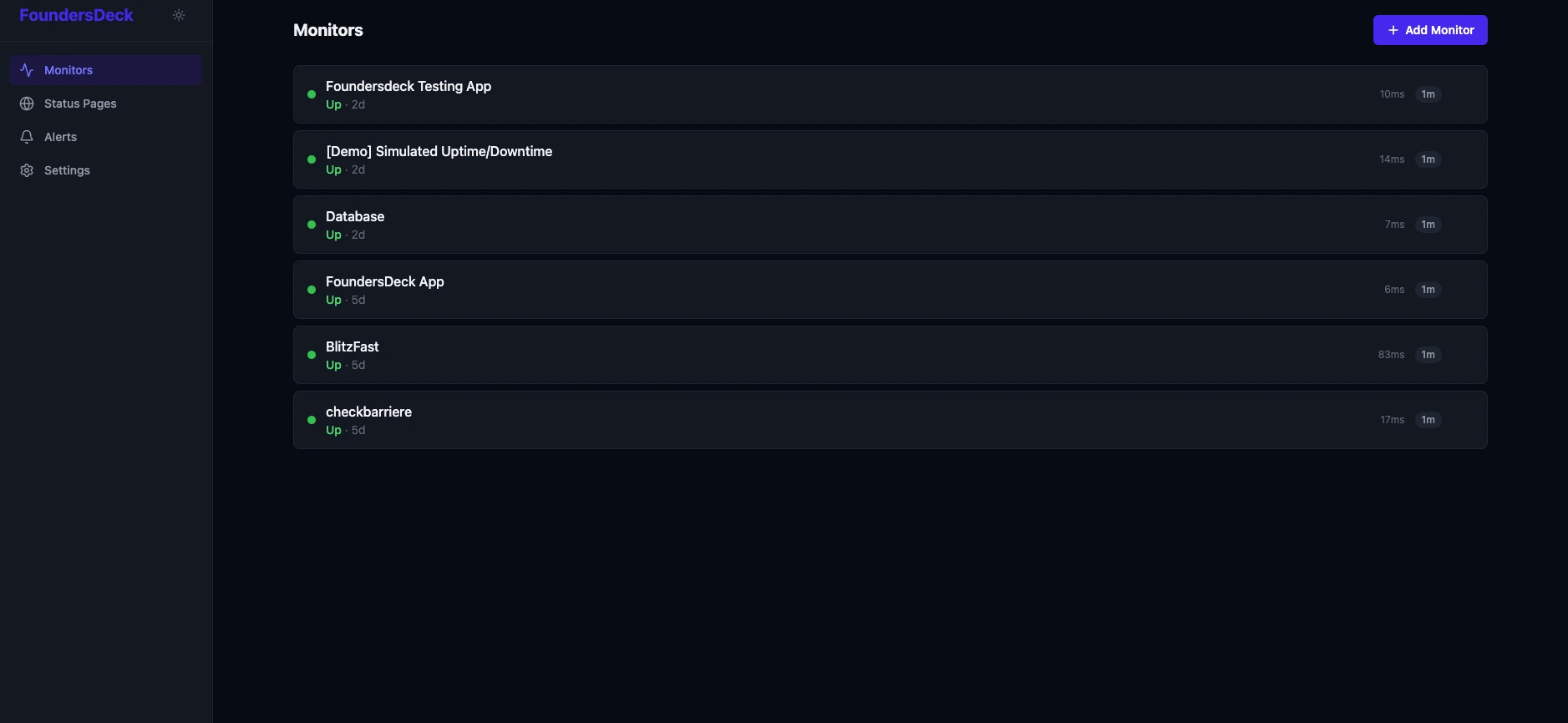
FoundersDeck is an EU-first reliability platform built in Germany, hosted exclusively in Nuremberg on Netcup infrastructure. Most monitoring tools cover only one of the three things you actually need to know about your stack — FoundersDeck combines all four in a single platform:
- Uptime monitoring — HTTP, Ping, and Keyword checks at 30-second intervals, with automatic incident classification (SSL, DNS, timeout, HTTP — not just “down”)
- Heartbeat / cron monitoring — monitor cron jobs, background workers, and backup scripts. Your service pings a unique URL after each run; if the ping stops arriving, you get alerted within seconds. One curl command, no agent.
- Public status pages — branded, custom-domain, cookie-free (no consent banner needed). Show uptime + heartbeat monitors side-by-side to your customers.
- Multi-channel alerts — Email, Slack, Discord, Webhooks — within seconds of an incident, with auto-resolution updates.
What stands out:
- 100% German infrastructure — not “EU region available”, but exclusively German (relevant for BSI-conscious enterprise and German public sector buyers)
- Heartbeat + uptime in one tool — most EU competitors do uptime only
- Cookie-free status pages — zero tracking, zero third-party requests
- NIS2 Art. 21(2) ready — supports availability monitoring & incident reporting obligations
Pricing: Free tier (5 monitors, 1 status page, email alerts), paid from €9/month
Data residency: Germany (Nuremberg) exclusively — no transatlantic transfers for monitoring data
DPA: Instant download, no sales call
Best for: EU founders, indie hackers, and SaaS teams who want uptime + heartbeat + status pages + alerts in one affordable, GDPR-native platform — instead of stitching together UptimeRobot + Healthchecks.io + Instatus.
2. Oh Dear — Best for Laravel/PHP Teams
Oh Dear is a Belgian monitoring tool built by the team behind Spatie, well-known in the Laravel community. It offers uptime monitoring, broken link checking, certificate health, and scheduled task monitoring.
What stands out:
- Mixed content and broken link checking
- Certificate health monitoring with expiry alerts
- Built by a respected open-source team
Pricing: From €13/month (Mini, 5 sites; no free tier — 10-day trial)
Data residency: EU (Belgium)
Best for: PHP/Laravel teams who value the Spatie ecosystem and need advanced checks beyond basic HTTP monitoring.
3. Uptime Kuma — Best Self-Hosted Option
Uptime Kuma is a free, open-source monitoring tool you host yourself. If you have the infrastructure and expertise, it’s the ultimate in data sovereignty — your data never touches a third party.
What stands out:
- Completely free and open-source
- 90+ monitor types
- Self-hosted = complete control over data location
Pricing: Free (self-hosted)
Data residency: Wherever you host it
Caveat: You need to manage the infrastructure yourself. No hosted status pages, no managed alerts, no SLA.
Best for: Developers who want full control and don’t mind managing their own monitoring infrastructure.
4. HetrixTools — Best Budget Option (Caution: US Entity)
Correction (2026-07-03): earlier versions of this guide listed HetrixTools as Romanian. The product has Romanian roots, but the legal entity is HetrixTools, Inc., registered in the United States (Beaverton, Oregon) — per its own about page. That puts it under CLOUD Act jurisdiction like any US corporation, so we’ve reclassified it. It stays in this list because its free tier is the most generous here and many readers ask about it — but it is not an EU-jurisdiction option.
What stands out:
- Very generous free tier: 15 uptime + 15 server monitors at 1-minute intervals
- Blacklist monitoring included
- ⚠️ US-incorporated — CLOUD Act applies regardless of hosting region
Pricing: Free tier (15 monitors), paid from $9.95/month
Data residency: ⚠️ US legal entity; hosting locations not verifiable from public docs
Best for: Budget-conscious teams without EU jurisdiction requirements.
5. Phare — Best Modern EU Alternative
Phare is an Estonian uptime monitoring tool (Lightkeeper OÜ, Tallinn — often mislabelled as French because of the name) with a focus on modern UI and developer experience. It offers HTTP monitoring, SSL checks, incident management, and status pages on EU infrastructure.
What stands out:
- Clean, modern interface
- Estonian company, EU infrastructure (analytics hosted in Germany)
- Unusually generous free plan: capped by monitoring events, not features
Pricing: Free tier (100,000 monitoring events/month), Scale from €5/month base plus usage
Data residency: EU (multi-region Europe)
Best for: Teams who value a modern UI and want a lightweight, EU-based monitoring tool.
6. Statuspal — Best for Status Pages
Statuspal is a German status page provider. While not primarily a monitoring tool, it offers basic uptime checks alongside its core status page product.
What stands out:
- Excellent status page customization
- German company, EU infrastructure
- API-first approach
Pricing: From $46/month
Data residency: EU (Germany)
Best for: Teams where the status page is the primary need and monitoring is secondary.
7. Hyperping — Best for API Monitoring
Hyperping is a French monitoring tool with a focus on API monitoring and synthetic checks. It offers a clean interface and fast alerting.
What stands out:
- Fast alerting (claims under 30 seconds)
- API monitoring focus
- French company, EU infrastructure
Pricing: From $19/month (no free tier)
Data residency: EU (France)
Best for: API-heavy products that need fast alerting and EU data residency.
8. Healthchecks.io — Best for Heartbeat-Only Setups
Healthchecks.io is a Latvia-based (SIA Monkey See Monkey Do, Riga), open-source heartbeat / cron monitoring tool. It does one thing — making sure your scheduled tasks ping in on time — and it does it well. EU-hosted on Hetzner with a self-hosted option for teams that want full control.
What stands out:
- Open source, with a self-hosted option
- EU entity (Latvia), hosted on Hetzner
- Long-standing, well-maintained codebase
- Generous free tier (20 checks)
Pricing: Free tier (20 checks), paid from $5/month
Data residency: EU (Latvia entity, Hetzner hosting)
Caveat: Heartbeat only — no HTTP uptime monitoring, no public status pages. You will need a second tool for those.
Best for: Teams that only need cron / heartbeat monitoring and prefer open source. If you also need uptime monitoring or status pages, FoundersDeck combines all three on German infrastructure.
Comparison Table
| Tool | Hosting jurisdiction | Legal entity | CLOUD Act reach | Uptime | Heartbeat / Cron | Status Pages | Free Tier | Starts At |
|---|---|---|---|---|---|---|---|---|
| FoundersDeck | 🇩🇪 Germany | 🇩🇪 Germany | None | ✅ | ✅ | ✅ Cookie-free | ✅ 5 monitors | €9/mo |
| Oh Dear | 🇧🇪 Belgium | 🇧🇪 Belgium | None | ✅ | ✅ Scheduled tasks | ✅ | ❌ | €13/mo |
| Uptime Kuma | Self-hosted | — | None (you control) | ✅ | ❌ | ✅ Basic | ✅ Free | Free |
| HetrixTools | Unverified | 🇺🇸 USA | ⚠️ Direct | ✅ | ❌ | ✅ | ✅ 15 monitors | $9.95/mo |
| Phare | 🇪🇺 EU (multi-region) | 🇪🇪 Estonia | None | ✅ | ❌ | ✅ | ✅ | €5/mo+ |
| Statuspal | 🇩🇪 Germany | 🇩🇪 Germany | None | ✅ Basic | ❌ | ✅ | ❌ | $46/mo |
| Hyperping | 🇫🇷 France | 🇫🇷 France | None | ✅ | ❌ | ✅ | ❌ | $19/mo |
| Healthchecks.io | 🇩🇪🇫🇮 EU (Hetzner) | 🇱🇻 Latvia | None | ❌ | ✅ | ❌ | ✅ 20 checks | $5/mo |
Reading the table: Most EU monitoring tools cover only one or two of the three reliability primitives (uptime, heartbeat, status pages). Stitching together a multi-vendor stack (e.g. UptimeRobot + Healthchecks.io + Instatus) means three vendors, three sub-processor relationships, three DPAs to manage. FoundersDeck and Oh Dear are the only EU-hosted tools that combine uptime + heartbeat + status pages in a single platform — and FoundersDeck does so at one fifth of Oh Dear’s entry price.
Why two jurisdiction columns?
Hosting location and legal entity are not the same thing — and conflating them is the most common mistake EU buyers make. A US-incorporated company can host data in an EU datacenter and still be compelled to hand that data over to US authorities under the CLOUD Act, regardless of physical storage location. This is the post-Schrems II reality. An “EU region” toggle is not sovereignty — the operating entity’s jurisdiction determines which government can compel data disclosure.
For contrast: popular tools commonly marketed as “EU-compliant”
For reference, here is how three of the most popular monitoring platforms look under the same framework. BetterStack and Pingdom are US-incorporated; UptimeRobot is the inverse case — EU-owned since 2019, but running on US infrastructure providers per its own privacy policy:
| Tool | Hosting jurisdiction | Legal entity | CLOUD Act reach |
|---|---|---|---|
| BetterStack | 🇺🇸 US (EU region available) | 🇺🇸 US-incorporated | Yes |
| UptimeRobot | 🇺🇸 US infrastructure (AWS, Limestone Networks), data may leave the EEA | 🇪🇺 EU — UptimeRobot s.r.o., Slovakia | Indirect — via US-hosted infrastructure |
| Pingdom | 🇺🇸 US | 🇺🇸 US (SolarWinds subsidiary) | Yes |
For deeper dives on each, see UptimeRobot vs FoundersDeck, Pingdom vs FoundersDeck, and the BetterStack alternative for EU teams breakdown.
How to Choose
Need uptime + heartbeat + status pages in one tool, on German infrastructure? → FoundersDeck
Need to monitor cron jobs and background workers reliably? → FoundersDeck (combined) or Healthchecks.io (heartbeat-only, open source)
PHP/Laravel team with budget for premium tools? → Oh Dear
Want complete control and don’t mind ops work? → Uptime Kuma (self-hosted) or Healthchecks.io (self-hosted option)
Tight budget, basic uptime needs? → Phare or Hyperping (HetrixTools is cheaper still, but US-incorporated)
Status page is the main product? → Statuspal
API-heavy product, need speed? → Hyperping
Swiss company weighing EU hosting against Swiss data residency? → see our dedicated guide to GDPR-compliant monitoring for Swiss companies — revDSG, the Swiss country list, and when Swiss residency actually matters
A practical pattern: if you only need one of the three (uptime, heartbeat, or status pages), a single-purpose tool like Hyperping, Healthchecks.io, or Statuspal is fine. If you need two or all three, a combined platform avoids vendor sprawl, simplifies your sub-processor list, and usually costs less than the sum of the pieces.
Whatever you choose, make sure your monitoring tool actually keeps data in the EU — not just “offers an EU region.” Read our deep dive on UptimeRobot vs FoundersDeck and Pingdom vs FoundersDeck for detailed comparisons with the biggest US players, or our piece on the EU gap in uptime + heartbeat + status page tooling for the broader market context.
Frequently Asked Questions
What is the US CLOUD Act and how does it affect monitoring tools?
The CLOUD Act (2018) allows US authorities to compel US-incorporated companies to hand over customer data stored anywhere in the world, including in the EU. This is why “EU region available” is not the same as “EU data sovereignty” — the operating company’s legal jurisdiction determines which government can demand access, not the data’s physical location. For monitoring tools specifically, this matters because your monitor URLs, response times, and incident history reveal your infrastructure layout and outage patterns. If your tool is operated by a US entity, that metadata is reachable under the CLOUD Act regardless of hosting region.
What’s the difference between EU hosting and an EU legal entity?
EU hosting means the physical servers are located in the European Union — AWS Frankfurt, a Hetzner datacenter, a Netcup facility. An EU legal entity means the operating company is incorporated in an EU member state and therefore subject to EU law (including GDPR) and not subject to non-EU data access laws like the CLOUD Act or FISA Section 702. A US company hosting in Frankfurt still falls under US jurisdiction — this is the post-Schrems II reality that invalidated the EU-US Privacy Shield in 2020. True GDPR compliance for monitoring tools requires both: EU servers AND an EU-incorporated operator.
Does GDPR require monitoring data to stay in the EU?
GDPR does not explicitly require data to physically stay in the EU, but it does require transfers to non-EU jurisdictions to meet specific safeguards — typically Standard Contractual Clauses (SCCs) or an adequacy decision. After Schrems II (2020) invalidated the EU-US Privacy Shield, many DPAs and legal teams consider SCCs insufficient protection against CLOUD Act access — a position formalised in the EDPB Recommendations 01/2020 on supplementary measures. In practice, for most EU businesses whose monitoring touches any personal data (team member emails for alerts, status page visitor metadata, user identifiers in incident notifications), choosing an EU-hosted AND EU-operated monitoring tool avoids the entire transfer-mechanism discussion. It’s not strictly required by the letter of the law — but it’s the only path that’s legally clean end-to-end.
Is UptimeRobot GDPR compliant?
UptimeRobot has been EU-owned since 2019 — it is operated by UptimeRobot s.r.o. in Bratislava, Slovakia (part of the itrinity group), so the company itself is not subject to the US CLOUD Act by incorporation. The catch is data residency: UptimeRobot’s own privacy policy names US infrastructure providers (AWS for sending monitoring requests and storing data, Limestone Networks, DigitalOcean) and states that data may be stored and accessed outside the EEA. Post-Schrems II, each of those transfers needs documented safeguards, and data held by US-operated providers remains within reach of US legal process. For strict GDPR compliance, tools that are both EU-incorporated and EU-hosted end-to-end — Oh Dear (Belgium), Healthchecks.io (Latvia), FoundersDeck (Germany) — avoid the transfer-mechanism question entirely.
Are there EU-hosted alternatives to BetterStack?
Yes. BetterStack is a US-incorporated company, which means even its EU hosting region doesn’t eliminate CLOUD Act exposure. EU-native alternatives that combine uptime monitoring and status pages include Oh Dear (Belgium, from €13/month), Hyperping (France, free tier, paid from $24/month), and FoundersDeck (Germany, €9/month with a free tier). For teams whose core differentiator is data sovereignty, switching to an EU-incorporated provider is the only way to close the CLOUD Act gap — no SCC, no privacy addendum, and no “EU region” toggle is a substitute for EU legal jurisdiction.
Which EU providers offer GDPR-compliant public status pages?
Three EU-incorporated providers offer GDPR-compliant status pages: Statuspal (Germany, $46/month), Oh Dear (Belgium, from €13/month), and FoundersDeck (Germany, €9/month with a free tier). FoundersDeck’s status pages are cookie-free by default — no consent banner needed for visitors, which matters because every status page visitor is a data subject the moment analytics or tracking cookies load. Atlassian Statuspage is operated by Atlassian (US-incorporated, Nasdaq: TEAM), which places it under CLOUD Act jurisdiction regardless of chosen hosting region. For teams that need status pages plus uptime and heartbeat monitoring in one EU-native tool, FoundersDeck and Oh Dear are the only options. Teams evaluating status page providers should verify both the hosting location and the legal jurisdiction of the operating entity — a distinction that eliminates half the commonly-listed “GDPR-compliant” options in most comparison articles.
Is there a GDPR-compliant monitoring tool with a free tier?
Yes. Three EU-hosted options offer meaningful free tiers: Hyperping (France) includes 20 monitors free at 5-minute intervals, Healthchecks.io (Latvia) gives 20 heartbeat checks free, and FoundersDeck (Germany) provides 5 monitors, 1 status page, and email alerts at no cost. Uptime Kuma is also free if you self-host — the only option where you fully control the data without paying anything, at the cost of running your own infrastructure. For teams that need uptime, heartbeat, and status pages combined, FoundersDeck is the only EU-hosted option that covers all three with a free tier.
More GDPR-Compliant Tool Guides
Monitoring is rarely the only tool in your stack that touches personal data. We apply the same four checks — EU data residency, EU-incorporated operator, instant DPA, transparent sub-processors — to the rest of the founder toolchain:
- Best Error Tracking Tools for GDPR & EU Data Residency 2026
- Best Log Management Tools for GDPR & EU Data Residency 2026
- Best GDPR-Compliant Feature Flag Tools 2026
- Best LLM Observability Tools 2026 (GDPR & EU Hosting)
- Best GDPR-Compliant Product Analytics Tools 2026
All of this data — 57 tools, jurisdiction, hosting, CLOUD Act exposure, DPAs — is also available as a filterable open dataset: the EU SaaS Jurisdiction Database. And if you’re evaluating monitoring for a healthcare context — clinics, practices, or the vendors supplying them — see GDPR-compliant monitoring for healthcare. Selling into other regulated industries? We’ve broken down what those buyers will ask your monitoring setup to prove: DORA for SaaS vendors with financial-services customers, NIS2 monitoring as a managed service for MSPs, availability evidence for govtech vendors in public procurement, and professional-secrecy requirements for legal tech.

Engin Yildirim
Founder of FoundersDeck. 13+ years in software engineering. Building EU-first tools for founders.
Read more about me →